Golden Dome may grab the headlines, but the real prize is quieter and harder to see: the sensor, data and command layer that makes orbit legible before anything can be tracked, targeted or intercepted.
Anduril’s agreement to acquire ExoAnalytic Solutions looks, at first glance, like a standard defense-tech acquisition. It is nothing of the sort. The deal, announced on March 11, is Anduril’s first acquisition under its space unit and its 11th overall. Financial terms were not disclosed, and the transaction still needs regulatory approval. But the significance lies elsewhere: Anduril is buying not just a company, but a way of seeing space that fits neatly into the new logic of missile defense.
That matters because the next big contest in SpaceTech will not be decided only by who can launch faster or build bigger satellites. It will also be decided by who can make sense of a more crowded, more contested orbital environment in real time. Anduril has been moving in that direction since September 2024, when it said it was extending its Lattice software platform into space to monitor and manage orbital assets more autonomously. The ExoAnalytic purchase makes that earlier move look less like expansion and more like preparation.
The real asset is not the telescope. It is the catalog.
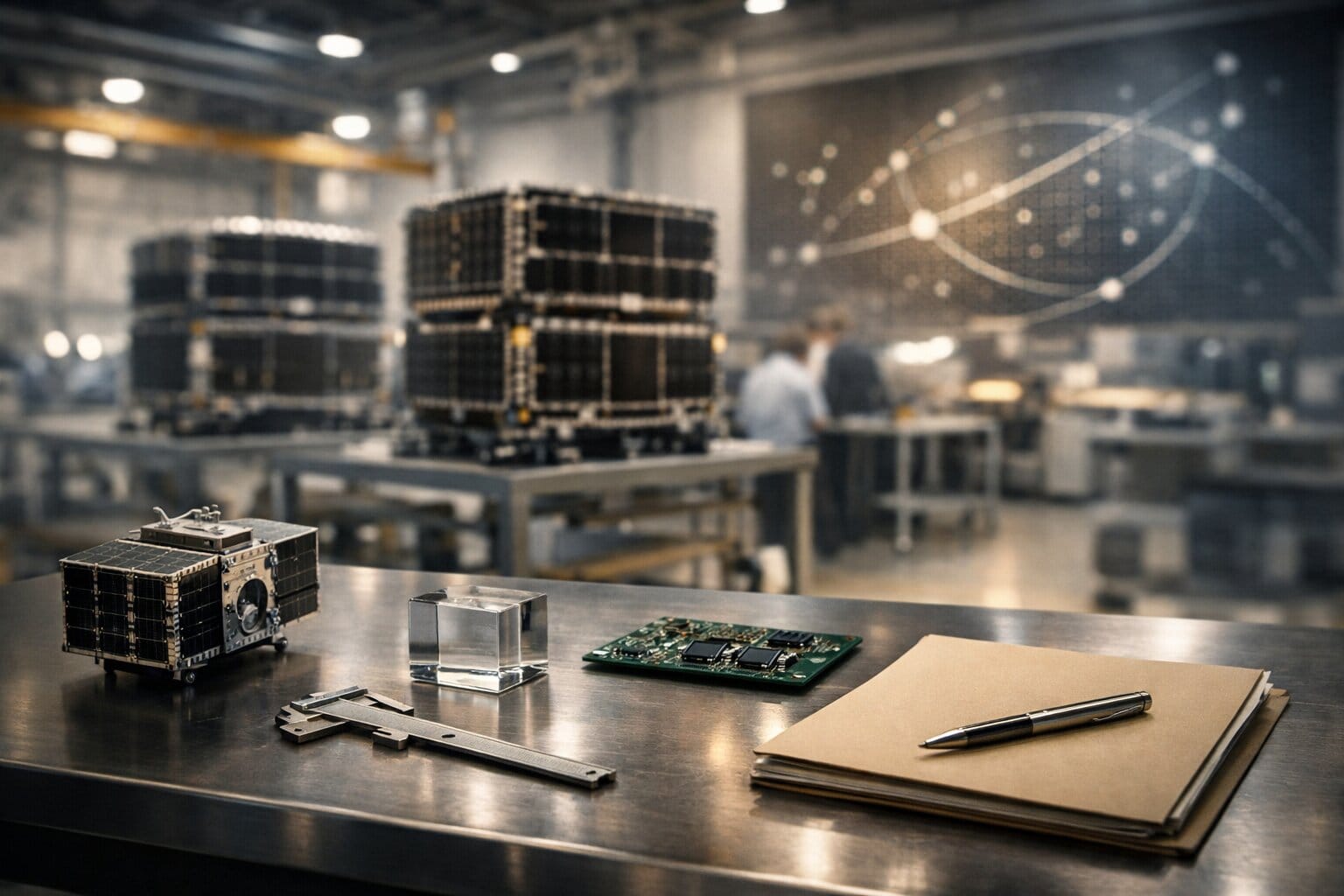
ExoAnalytic’s appeal is not mysterious. For more than a decade, the company says it has continuously monitored high-altitude space operations and built a database of billions of correlated observations, including detected maneuvers, anomalies and stability changes. It describes its ExoAnalytic Global Telescope Network as the world’s largest commercial optical telescope network, spanning 350-plus autonomous telescopes worldwide and focused on MEO, HEO, GEO and beyond. The company says the network can deliver roughly 18 hours of daily persistence, 15-to-30-second latency, and more than 99 per cent availability for each GEO longitude.
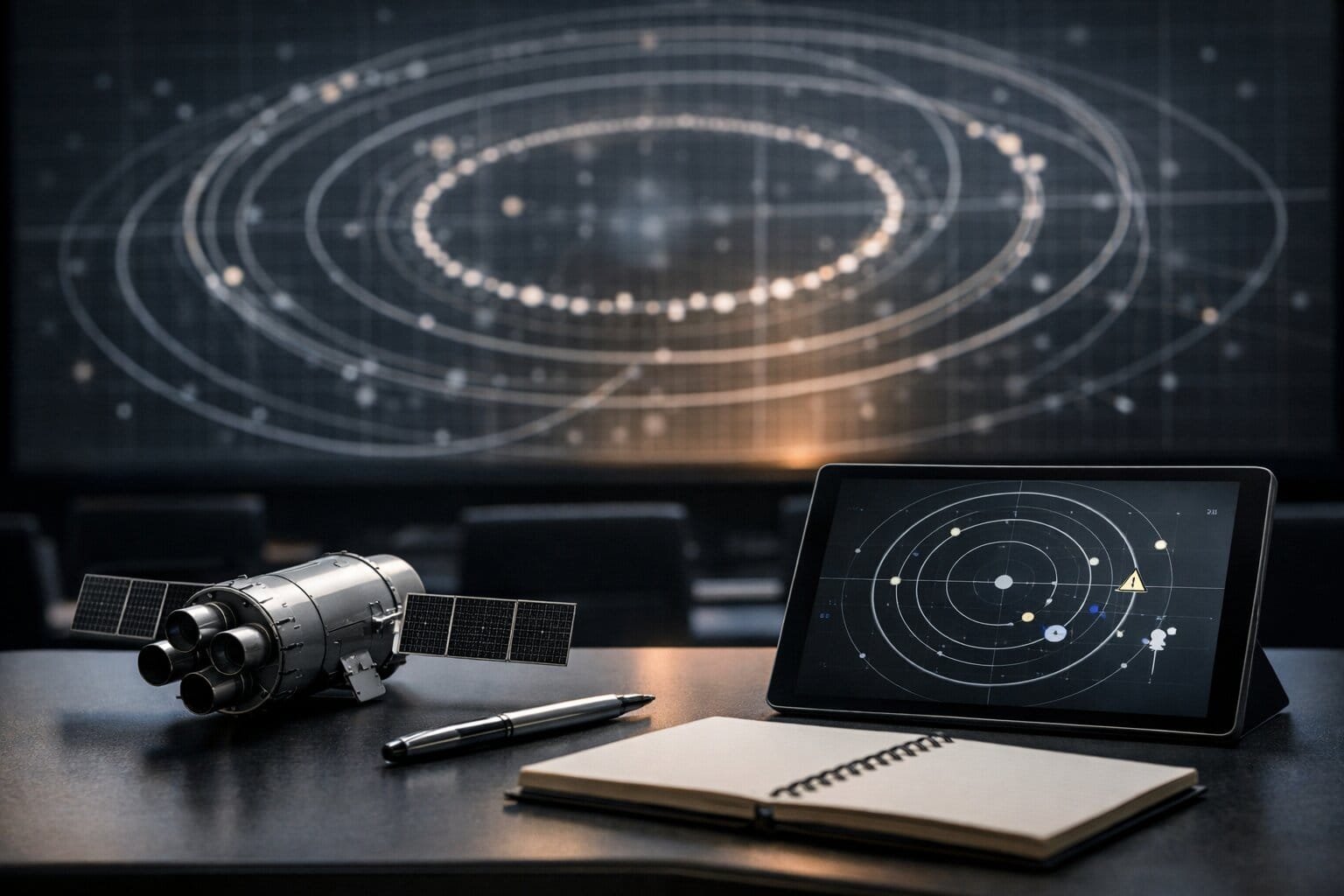
Those numbers may sound technical, but they point to the heart of the business. In military space, the scarce resource is not always the sensor itself. It is the trusted catalog: the constantly updated picture of what is in orbit, what has moved, what looks abnormal, and what might become a threat. That picture becomes more valuable as orbit gets busier. ESA’s 2025 Space Environment Report says about 40,000 objects are now tracked by space surveillance networks, of which around 11,000 are active payloads, while the broader debris population is vastly larger. In a market like that, awareness is no longer a support function. It is infrastructure.
This is why Anduril’s move matters beyond one company. A lot of the commercial space boom has been narrated through launches, constellations and valuations. But national-security space is increasingly about interpretation. The harder problem is not simply spotting something in orbit; it is deciding, quickly and credibly, whether that object’s behavior changes the military picture. ExoAnalytic’s value lies in compressing that gap between observation and judgment.
Golden Dome begins with seeing
The White House’s January 27, 2025 executive order for what was then called the “Iron Dome for America” made that logic explicit. It directed the Defense Department to produce a reference architecture that included accelerated deployment of a Hypersonic and Ballistic Tracking Space Sensor layer, proliferated space-based interceptors, and a “custody layer” within the Proliferated Warfighter Space Architecture. In plain English, the administration was not asking only for weapons. It was asking for a system that could find, follow and understand threats across a very large battlespace.
That is one reason the acquisition lands in such a politically charged moment. In April 2025, Reuters reported that SpaceX, Palantir and Anduril had pitched a Golden Dome concept involving 400 to more than 1,000 satellites to sense missiles and track their movement, alongside a separate fleet of 200 attack satellites armed with missiles or lasers. Reuters also reported that more than 180 companies had shown interest in helping build Golden Dome. By May, President Donald Trump announced a $175 billion Golden Dome design, even as Reuters reported that the Congressional Budget Office had estimated the project could cost as much as $831 billion over two decades.

In that context, ExoAnalytic does not look like an add-on. It looks like part of the answer to a deeper procurement question: who will own the layer that tells the rest of the system what is happening? The glamour in missile defense usually sits with interceptors. But before a missile can be intercepted, there has to be a defensible picture of the orbital and atmospheric scene around it. Custody comes before kill. That may prove to be one of the most important commercial truths in the next phase of military space.
Anduril is stitching together the stack
Anduril already had pieces of this story in hand. In November 2024, the company won a five-year, $99.7 million Space Force contract to modernize the Space Surveillance Network by integrating Lattice into a new mesh architecture known as SDANet. DefenseScoop reported that the goal was to replace older point-to-point communications with a more resilient network able to process and distribute data from a global array of military space sensors more efficiently. That contract said a great deal about where Anduril wanted to sit in the value chain: not just at the edge, with sensors, and not just at the top, with command software, but in the connective tissue between them.
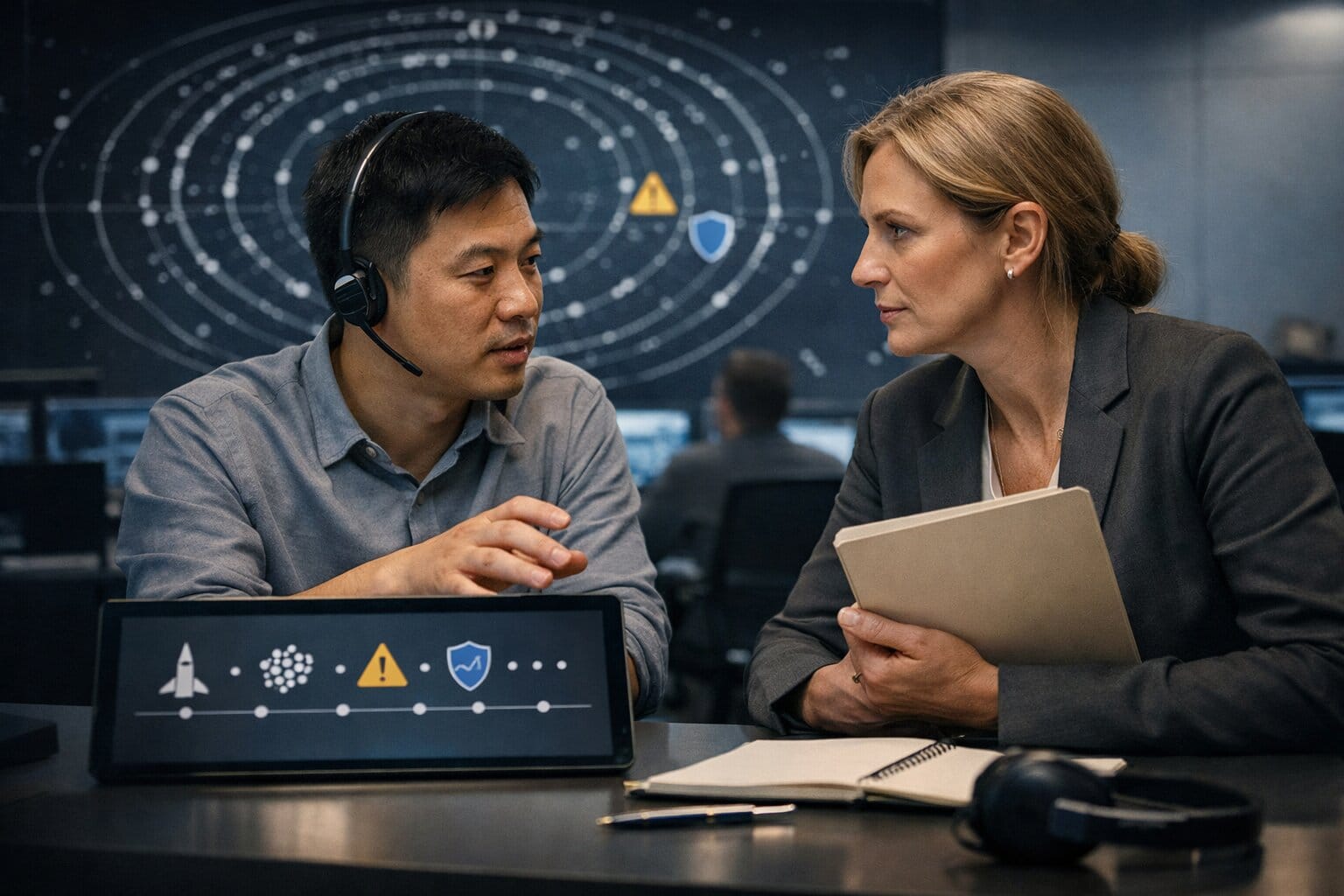
The ExoAnalytic acquisition pushes that strategy further. Reuters reported that ExoAnalytic brings more than 400 telescope systems globally, as well as modelling and simulation capabilities for classified national-security space programs and software expertise for missile warning and missile defense. Anduril, in turn, brings autonomy, command-and-control systems, battle management and a growing role in space-focused defense programs. Put differently, one side contributes the sensor picture and deep-space tracking heritage; the other contributes the operating logic to fuse that picture into action.
That combination is what makes the deal more interesting than a headline about “expanding space capabilities” might suggest. Traditional defense primes have long excelled at building large, exquisite systems. Silicon Valley-style defense companies, by contrast, tend to argue that the real bottleneck is software integration, decision speed and the cost of operating legacy architectures. In May 2025, Reuters noted the emerging view in Washington that the new defense ecosystem could lean more on Silicon Valley software and autonomy than on what one senator called “big metal.” The Anduril-ExoAnalytic pairing sits squarely inside that shift.
Why this matters for SpaceTech, not just defense
There is also a broader SpaceTech lesson here. For years, investors and founders have talked about space as if value would accrue mostly to launch providers, spacecraft manufacturers or downstream applications. This deal suggests another answer: some of the most defensible value may sit in the middle layer that converts raw orbital activity into usable judgment. That is especially true in national security, where the customer is often paying for confidence and speed, not merely hardware ownership.
ExoAnalytic’s business is a good example of that shift. The company does not just sell telescopes. It sells observation data, alerts, orbit products, tasking tools, image processing, catalogue reconciliation and expert support. In other words, it monetizes interpretation. That is exactly the kind of business model that becomes more valuable as orbit gets more congested and as governments become more anxious about hostile maneuvering, missile warning and space resilience.
For Anduril, that has strategic implications. If you can own or strongly influence the custody layer, you are not merely bidding to supply a component. You are positioning yourself closer to the logic of the whole architecture. That matters in any major defense program, but especially in one as fluid as Golden Dome, where the architecture is still evolving and where the government appears to be searching for combinations of existing systems, new satellite layers and faster software-defined integration.
But sensors do not repeal physics
That said, this is not a story about inevitability. Golden Dome remains unsettled. In January 2026, Reuters reported that much of the $25 billion available for the initiative had not yet been spent, that architecture decisions were still being debated, and that only a small handful of prototype contracts had been awarded, some worth roughly $120,000. The market excitement is real, but so is the uncertainty.
There is also a deeper strategic problem. Better awareness is necessary, but it is not sufficient. Reuters reported in April 2025 that critics questioned whether a space-based defense system would be technically feasible, affordable or survivable at scale; one expert warned that such a system could be overwhelmed by multiple weapons and might require extremely large constellations. In May 2025, Reuters also reported concerns that putting interceptors in orbit could accelerate the militarisation of space and encourage rivals to respond in kind. Seeing more clearly does not make those dilemmas disappear. It may simply make them arrive faster.
That is why this deal should be read carefully. It does not prove Golden Dome will work. It does not settle the argument over whether the United States can build a layered homeland shield on the timetable politicians have advertised. What it does show is where sophisticated defense companies think the leverage will be. Anduril is effectively saying that the next big contest in space will be won less by the company with the loudest launch narrative than by the one with the best orbital picture, the fastest software loop and the strongest claim to being indispensable inside the command chain.
And that may be the most important point of all. Space is no longer just a place where military systems sit. It is becoming a place that has to be continuously interpreted, managed and, if necessary, defended at machine speed. In that world, a telescope network is not merely hardware. It is a strategic map. Anduril’s bet is that whoever owns the map gets a better chance of shaping the warfighting system built on top of it.