A fighter pilot can learn a lot in a simulator. But there’s a reason air forces still put people in real aircraft before they trust them in combat.
Space is finally getting the same memo.
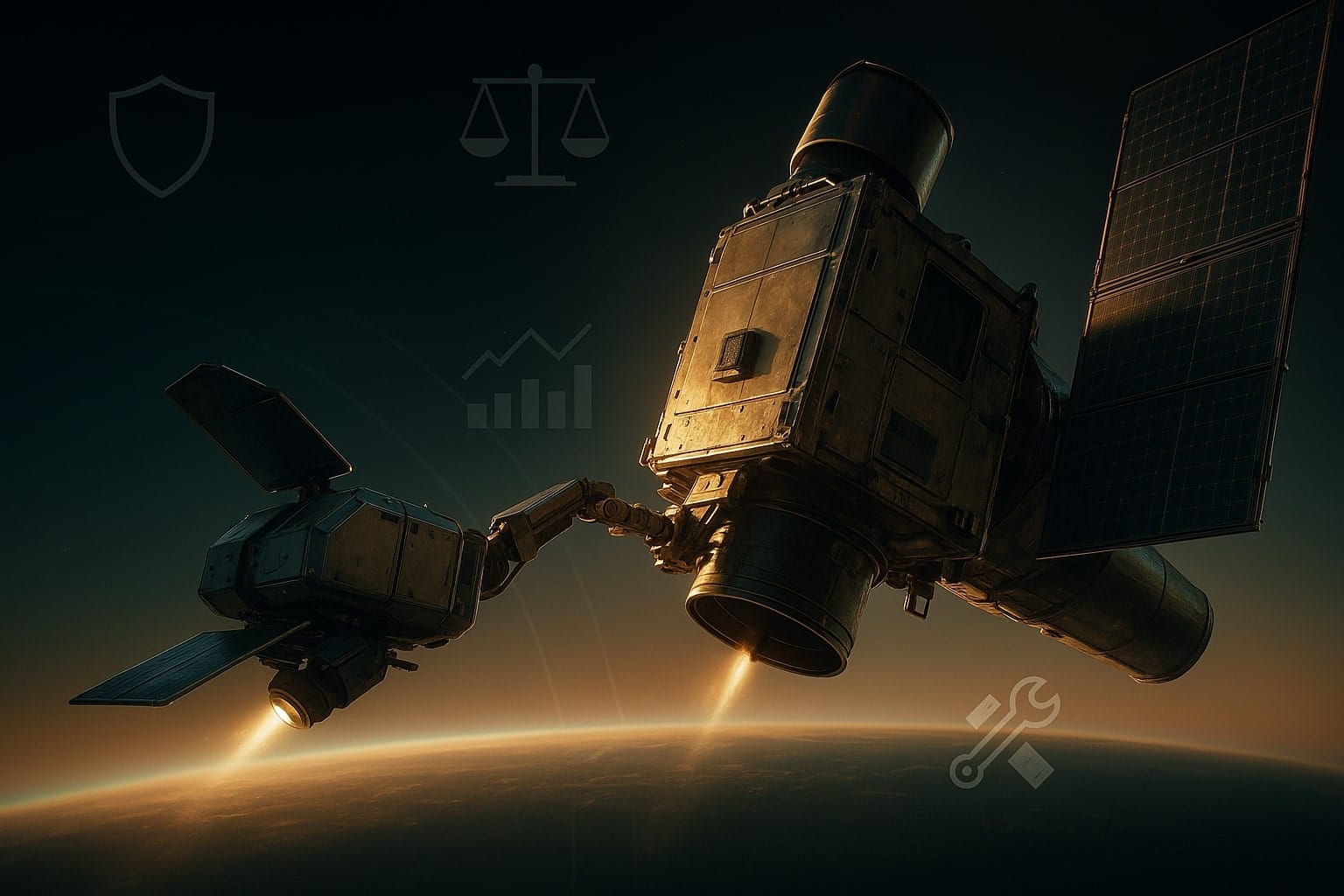
In late February, U.S. Space Force leaders disclosed that Mission Delta 9—the service’s orbital warfare unit—now has a live satellite it can fly for training, practicing “precise, advanced” maneuvers that senior officials described as both defensive and offensive in character.
The satellite was carried to orbit on USSF-87, a Feb. 12, 2026 national security launch on ULA’s Vulcan that also delivered payloads for the Space Force’s Geosynchronous Space Situational Awareness Program (GSSAP)—the “neighborhood watch” satellites used to keep tabs on activity near geosynchronous orbit.
If that sounds like a narrow training upgrade, it isn’t. It’s a signal that the Space Force is moving from a “supporting infrastructure” mindset—GPS, missile warning, comms—to something more blunt: space as a warfighting domain where movement, proximity, and tactics matter. And in space, “movement” is never just movement. It is fuel. It is lifespan. It is visibility to adversaries. It is escalation risk.
So what exactly did the Space Force just do—and why does it matter now?
A real spacecraft (and a deliberate lack of details)
Here’s what we know from official statements and reporting:
- The spacecraft is a prototype, maneuverable “demonstration” satellite intended to help Guardians train and refine “tactics, techniques, and procedures” (TTPs) for precision on-orbit maneuvers—especially in the geosynchronous regime.
- The Space Force has not named the satellite’s mission and has not identified the vendor. Lt. Gen. Gregory Gagnon, head of Space Force Combat Forces Command, explicitly declined to provide those details, framing the secrecy as protection of the industrial base.
- USSF-87 did not just loft a single spacecraft. Reporting indicates a forward spacecraft (GSSAP) and an “aft” vehicle described as a propulsed ESPA (a payload adapter/bus) flying multiple payloads into a direct-inject GEO mission profile—useful context for how this “trainer” may have ridden to orbit.
That last point matters because it hints at where this is headed: training satellites that look and feel like operational systems, not repurposed leftovers.
As one senior leader put it, the unit used to train with something akin to a “737.” Now it has something closer to a “military-grade aircraft.” (Short quote; long implication.)
Who is Mission Delta 9—and what do they actually do?
Mission Delta 9 is not a generic ops unit. It is the Space Force’s orbital warfare formation—tasked to “generate combat-ready” forces for full-spectrum orbital warfare operations, experimentation, and tech demonstrations.
Its structure reads like a job description for a future where proximity in orbit is normal:
- 1st Space Operations Squadron: space-based surveillance and close-proximity reconnaissance, including characterization of resident space objects in GEO.
- 3rd Space Operations Squadron: forces that can “close with and defeat enemy forces in space,” plus an orbital warfare contingency response construct and live on-orbit experiments.
- 9th Combat Training Squadron: builds tactical skills, intelligence and weapons/tactics understanding for orbital warfare crews.
So when the Space Force says “we’re training advanced maneuvers,” this isn’t abstract. This is the part of the enterprise that’s meant to be hands-on with the messy physics and messy signaling of real-space interactions.
The training problem: you can’t reserve a “range” in orbit
In the air domain, you can carve out training ranges, schedule “red air,” and keep exercises behind fences. In space, you don’t get that luxury.
Space Force leaders have been unusually candid about the gap:
- In late 2025, Gagnon said “40 percent” of his units didn’t have a realistic trainer for practice—despite spending “significant money” on Operational Test and Training Infrastructure (OTTI).
- The service has leaned heavily on synthetic environments partly because live on-orbit training is expensive and can be observed, and because you can’t “stake a claim” to a secure slice of the domain the way you can on Earth.
That’s why the Space Force has been building a hybrid stack:
- A distributed digital training environment called SWORD (Space Warfighter Operational Readiness Domain), described as the backbone “network operating system” for synthetic training.
- A planned National Space Test and Training Complex (NSTTC), envisioned as interconnected physical and digital ranges—with the Space Force having requested $141 million for that effort in its FY 2026 budget request (per reporting).
- A new acquisition structure: System Delta 81, stood up to accelerate high-end test, training, tactics development and live ranges for STARCOM and operational users.
And yet: every experienced operator will tell you the same thing. Simulators get you reps. Reality gives you judgement. In space, judgement is the difference between a controlled proximity operation and a headline-making misinterpretation.
Why “maneuver” suddenly matters so much
For decades, most military satellites behaved like infrastructure. They stayed predictable. They conserved fuel for station-keeping. They avoided drama because drama shortened mission life.
Now the logic is flipping. The Space Force and U.S. Space Command have been pushing the idea of dynamic space operations—frequent repositioning, adaptability across the whole architecture, and eventually on-orbit logistics (refueling, servicing, repair) to make maneuver sustainable.
The Mitchell Institute’s 2025 framing is blunt: dynamic operations are not just “move satellites more.” They’re about methods that increase versatility and maneuverability across the space enterprise, intertwined with on-orbit logistics.
But there’s an immediate constraint: fuel.
As Air & Space Forces reporting notes, mobility for many satellites is still limited by the propellant they carry—often sized for station-keeping, not aggressive maneuvers. And in GEO, the economics of that limitation are enormous: the orbit hosts more than 500 large, high-value satellites, many designed for decades-long service—precisely the kind of assets where “maneuver without regret” becomes strategically attractive.
The U.S. is responding on two tracks:
- Train the people (Mission Delta 9 + on-orbit trainers + SWORD).
- Evolve the logistics (servicing/refueling demonstrations slated for 2026, per reporting) so movement isn’t a one-way ticket to early retirement.
The new training satellite sits squarely in track one—but it’s designed to inform track two. Space Systems Command described USSF-87’s demonstration system as testing technologies to enhance resiliency and protection for future programs of record.
Translation: today’s training is also tomorrow’s acquisition blueprint.
The invisible backdrop: orbit is crowded, and it’s getting harder to tell stories with certainty
Space operations happen in a domain where a lot is trackable, but not everything is interpretable.
A few numbers help:
- The Space Force’s space surveillance enterprise has been described as tracking 60,000 objects in orbit and sharing data through 200+ agreements with allies and commercial operators.
- ESA’s 2025 Space Environment report says ~40,000 objects are tracked by space surveillance networks, including ~11,000 active payloads.
Those counts matter because proximity operations are not performed in a vacuum—literally or politically. When something maneuvers near something else, three narratives can form at once:
- It’s normal ops (inspection, anomaly resolution, servicing).
- It’s counterspace (denial, interference, coercion).
- It’s an accident in slow motion (miscalculation, collision risk).
A live training satellite helps with #3 by building competence. But it can intensify #2 if outsiders misread what they see.
“Hand-me-downs” vs purpose-built trainers: the Space Force is choosing realism (and accepting the consequences)
Until now, much “live” training has been constrained and often dependent on repurposed assets—what one senior enlisted leader candidly called “hand-me-downs.”
The Space Force is trying to move beyond that by building an ecosystem of training tools:
- Dedicated on-orbit training satellites (the path implied by this new prototype).
- Aggressor/target/threat-replication concepts to mirror what air forces do with “red air”—but in a domain where “red” might watch your every move.
- System Delta 81 to accelerate “high-end advanced test, training and tactics,” distributed training, and live ranges.
The interesting operational detail from Aviation Week is that the Space Force frames this as a vendor learning problem, too: different spacecraft “handle differently,” and building tactics that map to real hardware matters.
This starts to resemble modern airpower development: aircraft, tactics, and training pipelines co-evolve. The twist is that orbit adds a layer aviation doesn’t: every maneuver is public telemetry for anyone who can observe it.
China’s maneuvering era is already here—and it shapes U.S. urgency
The Space Force’s training push isn’t happening in a calm neighborhood.
In mid-2025, outside analysts and tracking firms reported Chinese spacecraft conducting rendezvous and proximity operations in geosynchronous orbit in what was widely interpreted as part of an on-orbit servicing/refueling demonstration.
And U.S. officials have been increasingly direct about what that implies: a future where spacecraft don’t just “exist” in orbit—they contest it.
You don’t need to accept every public characterization of Chinese intent to see the strategic driver: if your competitor is learning to maneuver, inspect, dock, and potentially refuel in GEO, then staying static becomes a choice—not a default.
The Space Force’s answer is to turn training into a force multiplier: build the tactics muscle now, so future mobility isn’t wasted—or worse, dangerous.
The uncomfortable question: how do you train for orbital warfare without making orbit less safe?
This is the real policy tension buried under the “cool new satellite” headline.
Live training improves competence. But it also:
- Creates more visible maneuvers in a domain already under surveillance, inviting misinterpretation.
- Raises deconfliction stakes: safe-distance norms and “behavioral signaling” are still evolving.
- Pushes space traffic management into a warfighting context, where predictability can no longer be assumed.
In other words, the Space Force is walking into a world where “readiness” and “restraint” are linked. You can’t optimize one without affecting the other.
One way to read the current approach—heavy virtual training plus selectively chosen live satellites—is that it’s trying to capture the best of both:
- Use synthetic environments for the playbook you don’t want observed.
- Use live on-orbit assets for the physics, the friction, and the judgement you can’t fully simulate.
That’s a sensible model. But it depends on something bigger than technology: shared expectations about what “normal” maneuvering looks like in GEO.
Because once multiple major powers treat orbit as maneuver space, orbit becomes less like a highway and more like a crowded roundabout—with everyone insisting they have the right of way.
What to watch next
This training satellite is a beginning, not an end. Three near-term indicators matter more than the hardware itself:
- Does the Space Force buy a “fleet” of trainers?
Leaders have already argued that just as some F-35s are purchased for test and training, some satellites should be dedicated training elements. - Does SWORD become the common operating layer for industry models?
Officials have described the next step as getting industry to deliver virtual/constructive models of satellites and weapons systems that plug into the synthetic environment. - Does “maneuver without regret” become real via on-orbit logistics?
The Space Force has tied the future of mobility to servicing/refueling demonstrations and a broader dynamic operations concept.
If those three lines converge—live training + scalable synthetic ranges + refueling/servicing—then “space superiority” stops being rhetoric and starts being an operational system.
And that’s the point.
The Space Force didn’t just launch a training satellite. It made a bet: that the next decade of national security space won’t be decided only by who has more satellites—but by who can move, adapt, signal, and sustain operations in the most crowded, most watched environment humans have ever built.